Drywall Repair in Accokeek, Maryland
Punctured walls, cracks that reopen, basement board ruined by a leak and ceilings beginning to bow: each one put right, its texture carried across the repair, and the surface left primed for your color.
A drywall professional working around Accokeek returns your call, hears what happened and arranges the quote.
Call 7 days, 7am–9pm
A written price reaches you first, and the calendar stays empty until you say yes.
Handle a leak in this order
Once water has reached a wall or ceiling, the sequence of what you do next counts for more than how soon fresh paint goes on. In a finished basement, where the board typically stops just above a concrete slab, sequence counts for even more.
- Shut the water off. Turn the valve closest to the leak, or the main valve if the source is hidden. With a roof or window leak, collect the drip indoors and cover the opening from outside when conditions allow.
- Make the ceiling safe. Where a ceiling has started to bulge or drip, the first move is to turn off the circuit at the electrical panel for every light and fan close to the wet patch. Only then clear the room underneath and keep everyone, animals included, away from it. A pail set beneath the lowest point gathers whatever comes through.
- Dry the space. Set up fans and a dehumidifier, draw furniture and rugs back from the wall, and pry off baseboards wherever water touched the floor. The EPA's guidance is to dry water-damaged areas and items within 24 to 48 hours to prevent mold growth.
- Take readings, then decide. A moisture meter reveals whether the gypsum has dried or is still holding water behind the paint. Gypsum that stayed saturated, crumbled or swelled comes out above the top of the wet zone, together with any sodden insulation. Gypsum that dried hard and shows only a ring can generally remain, coated with a stain-sealing primer ahead of paint.
Accokeek lies in the humid subtropical climate zone, and its summer air is heavy with moisture, so a basement may stay damp long after the face of the wall feels dry to the hand. Meter numbers, not looks, should set the date for rebuilding. The basement water-damage page explains how that rebuild is approached.
Weigh a weekend fix against a booking
Plenty of small blemishes suit a spare Saturday afternoon, and nobody needs to be called about them. Others look trivial yet sit on top of a cause that spackle will never reach. The two lists below are a sensible way to tell them apart.
Usually manageable by the household
- A fastener head that has pushed up a small bump
- Dings from chair backs or a vacuum
- A fine hairline crack that has stayed the same length
- Anchor holes from a removed shelf or television bracket
Reasons to request a quote instead
- An opening wider than your palm
- Anything overhead, or anything a stepladder will not reach
- Board that is spongy, smells musty or was soaked
- A crack that reappeared after an earlier patch
- Knockdown or orange-peel finish you doubt you can copy
The guide to home patching and its limits lists the tools for each small job and the point at which it stops being one.
Choose your problem to begin
Select whichever description comes closest to the damage. The contact page then opens with that choice already selected, and you may add particulars there, or simply phone if you prefer.
Pick the service that fits
Each page below sets out the usual cause, what a sound repair involves, and what deserves watching in the months after.
Basement Water Damage
Board soaked by a split supply line, a sump that quit or a seeping foundation wall is measured, opened up and rebuilt.
See how a soaked basement wall is rebuiltCrack Repair
Wall and ceiling crack repair aimed at the joint that moved, not merely the line showing in the paint.
Read about crack repairCeiling Repair
Bowed panels, leak rings and corner splits, including two-story rooms and vaults that call for staging.
Ceiling repairs in tall and wide roomsHole Patching
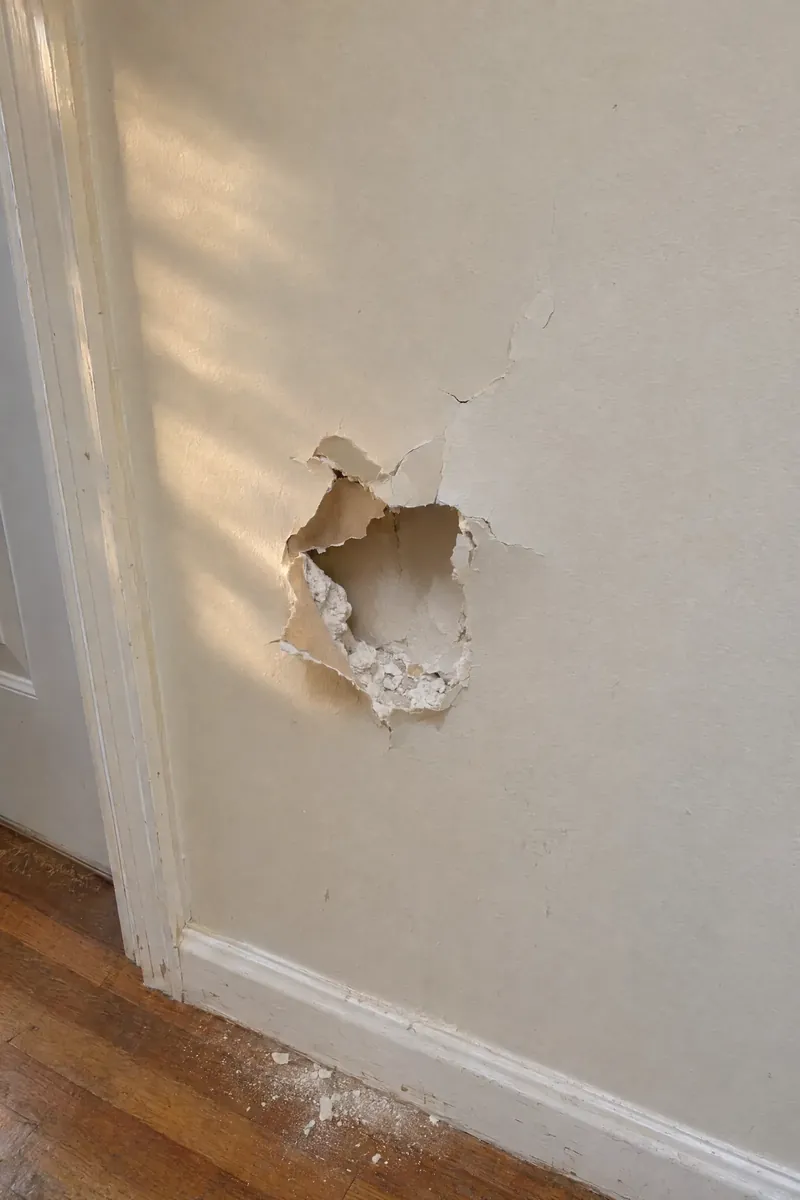
Drywall patching for doorknob punctures, ripped-out anchors and wider impact damage, finished level with the surrounding surface.
How holes are patched and finished
Set fair expectations for the work
Containing the sanding
Sanding cured compound throws off a powder fine enough to drift through a house. Plastic across doorways, a covered floor and a HEPA shop vacuum keep the bulk of it inside the room. Before accepting a quote, it is fair to find out what dust control is planned and which surfaces will be covered.
Waiting between coats
Every layer of compound must cure before the next is applied. A small repair done with setting compound can take more than one coat in a single day; a whole basement wall or a ceiling section usually needs overnight curing and often stretches over more than one visit.
Primer, then color
Bare compound has to be primed before it is painted. Touching up a single spot on older paint can leave a faint difference in sheen, so rolling the wall from corner to corner is the most dependable way to blend it. Please ask whether primer and paint are part of the quote.
Judging the result
A carefully finished repair is difficult to locate from across a room. With low sunlight skimming the wall, a practiced eye can occasionally find an edge, which is why the texture and how far each coat is feathered deserve as much attention as the patch.
The account of how a request is handled follows a job from the first conversation to a wall ready for its finish coat.
Account for the age of your house
Five-year Census estimates covering 2020 to 2024 put 1,119 of Accokeek's 4,464 homes before 1970, with 655 of those built during the 1960s. Much of the community west of Route 210 belongs to the Moyaone Reserve, a district of mid-century, individually designed houses on wooded lots of at least five acres, placed on the National Register of Historic Places in 2020.
Houses from the 1950s or before may have plaster over wood or gypsum lath rather than drywall. Plaster that has parted from its lath needs reattaching before any crack is filled, and a hole in plaster is rebuilt coat by coat to the full thickness of the wall. Diagonal cracks over doors and windows in an older house generally come from slow movement repeated season after season, so they are taped and finished to tolerate a little flexing instead of simply being packed with filler.
Old paint is the other consideration. According to the EPA, houses put up before 1978 more often carry lead-based paint, and anyone paid to disturb painted surfaces in a house of that vintage is subject to the agency's Renovation, Repair and Painting rule. If your house predates 1978, ask the pro how dust from cutting and sanding will be contained.
Plan rental repairs between tenants
Rented houses make up a modest part of Accokeek; those same estimates show 150 renter-occupied homes against 4,414 occupied ones. Their owners still have particular timing problems to solve.
- Walk through at move-out. Photograph each anchor hole, scuffed corner and crack, room by room, and send the full list together so the house can be priced as a single job.
- Group the rooms. Combining several minor repairs into one booking usually works out cheaper per patch than arranging each as it turns up.
- Agree on access in advance. Let us know who will unlock the door and when. With a tenant in residence, give whatever notice the lease requires before a date is fixed.
- Allow for the painter. When the unit is being repainted between occupants, put the drywall first in line so the painter rolls over primed, fully cured patches.
Sort urgent damage from the rest
Arrange these soon
- A ceiling holding water. Turn off power to every fixture in that stretch of ceiling first, then clear the room; a waterlogged panel can drop all at once.
- Basement board that got wet. Mold can take hold within a couple of days, so soaked gypsum is opened and dried rather than painted over.
- A crack that is spreading. Cracks lengthening week on week, or appearing together with doors that suddenly bind, may signal movement for a structural engineer to assess before any drywall work.
- An opening with wiring inside. Keep it covered and well out of reach until it can be properly closed.
Leave these for a convenient date
- Nail pops. Unsightly yet harmless, and easily folded into one visit along with other small items.
- Hairline cracks that hold still. If pencil ticks at each end show no change after a month, the crack can go on a later list.
- Old, dry rings. After the leak has been repaired and the gypsum confirmed dry, a ring is purely cosmetic.
- Dents and small punctures hidden behind furniture or inside closets.
Find your community on the map
Officially a census-designated place within Prince George's County, Accokeek sits roughly 17 miles from Washington, D.C., and the Potomac River bounds it on the west. Requests are equally welcome from the neighboring communities shown here.
- Fort Washington, Prince George's County: north of here.
- Clinton, Prince George's County: northeast of here.
- Brandywine, Prince George's County: east of here.
- Waldorf, Charles County: east-southeast of here.
- Bryans Road, Charles County: southwest of here.
- Indian Head, Charles County: west-southwest of here.
Each place has a paragraph to itself on the page listing the areas served.
Record the damage before cleanup
Whether you mean to contact an insurer, inform a landlord or simply keep a file of your own, a careful record made before anything is disturbed helps everyone concerned. Coverage is a question for your insurer alone; the points below are only about producing a good record.
- Photograph each affected room from the doorway so the position of the damage on the wall or ceiling is obvious.
- Take close-ups with a ruler or folding rule held beside each ring, hole or crack to show its size.
- Capture the cause as well: the pipe, the window frame, the water heater or the section of roof involved.
- On basement walls, pencil the top of the water line and photograph it before any board is removed.
- Write down the date the damage came to light and the date the water was finally stopped.
- Hold on to receipts for fans, dehumidifiers and anything else bought or hired to dry the space.
Trace each symptom to a likely source
The table sets what you can see beside its most frequent cause, and names the page where that repair is described.
| What you see | Likely cause | Repair page |
|---|---|---|
| A crack angling away from the corner of a door or window | Framing movement gathering at the weakest point of the opening | cracks at doors and windows |
| A straight crack following a seam | Joint tape that no longer grips, or a joint given too little compound | seam and tape failures |
| A small circular bulge or an exposed screw head | A fastener working loose as framing lumber dries and moves | nail pops and small patches |
| A blister or bubble under the tape | Tape bedded on too little compound, or moisture behind it | blistered tape |
| A brownish ring spreading on the ceiling | Water from a pipe, a roof leak or condensation above | stained ceilings |
| Spongy, swollen gypsum at floor level | Water wicking up from a basement slab or a plumbing leak | swollen basement board |
| A ceiling dipping between framing members | Soaked board, or fasteners that have torn through the paper | sagging ceiling panels |
Arrange your repair quote
Tell us about the damage by phone, send a picture, or complete the form. The price comes first, and work is scheduled only when you are ready.
Whoever prices your job will phone to go over it with you and settle on a date that suits.